
Read the Instruments in Midland County Deed Records
The Midland County Register of Deeds accepts warranty deeds, quitclaims, land contracts, releases, powers of attorney, liens, plats, and amendments. Each instrument touches real property differently. A label only hints at the purpose. The parties, granting language, legal description, reservations, and recording reference decide what the deed actually says.
| Instrument | Recorded Purpose | Typical Research Use |
|---|---|---|
| Warranty deed | Conveys the stated interest with title covenants | Many ordinary sales |
| Quitclaim deed | Conveys whatever interest the grantor holds | Family transfers or title cleanup |
| Land contract | Records a contractual land-sale relationship | Installment transactions |
| Trustee or representative deed | Conveys under trust or estate authority | Probate and trust administration |
| Tax conveyance | Follows a statutory foreclosure process | Tax-foreclosed land |
Mortgages, liens, assignments, releases, and easements often sit beside deeds yet convey no ownership. Hunt for the discharge too, not just the burden.
Midland County Deed Coverage Crosses Three Eras
The office holds land records back to 1855. The online trail runs strongest from 1949 forward. Records from 1968 on are scanned and computer indexed. Material from 1958 through 1968 comes in searchable Adobe form. Pre-1958 name indexes work through Simple Search, older books and microfilm wait in the vault, and back-indexing continues.
| Period | Finding Aid | Next Access Point |
|---|---|---|
| 1968 to present | Computer index and scanned records | Fidlar route or office |
| 1958 to 1968 | Searchable Adobe material | Online system, then image review |
| Before 1958 | Name indexes and older references | Vault books and microfilm |
| 1855 onward | County custody | Register staff and physical holdings |
A blank screen does not mean no deed exists. That is what the date split teaches. An old address may never have been indexed, so the land may appear only by subdivision, lot, section, township, and range.
Walk Midland County's Grantor-Grantee Chain
Deed indexes track people and entities, not street addresses. Start with the grantee on the latest known purchase. Read the grantor named in that instrument, then search that same person as a grantee in an earlier span. Keep repeating only while the legal description and references still match the same land.
- Find the present owner's acquisition with that owner listed as grantee.
- Record its grantor, date, reference, and legal description.
- Search the prior owner as grantee in an earlier period.
- Test former names, spelling variants, trusts, and business names.
- Move to vault indexes and books when the digital period ends.
- Grantor
- The party transferring the stated interest.
- Grantee
- The party receiving the stated interest.
- Chain of title
- The connected sequence of recorded transfers for the same land.
- Book/page or instrument number
- The retrieval reference assigned to a filing.
Note: A tidy name chain can still skip probate authority, a parcel split, an easement, or an unrecorded interest.
Use Midland County's Current Fidlar Doorways
The official Register of Deeds page links Tapestry EON and Laredo today. Vendor URLs, account rules, and payment habits shift, so start at the county's own page. Check whether each hit is an index or image. The Tapestry EON entry shows the public land-record doorway.
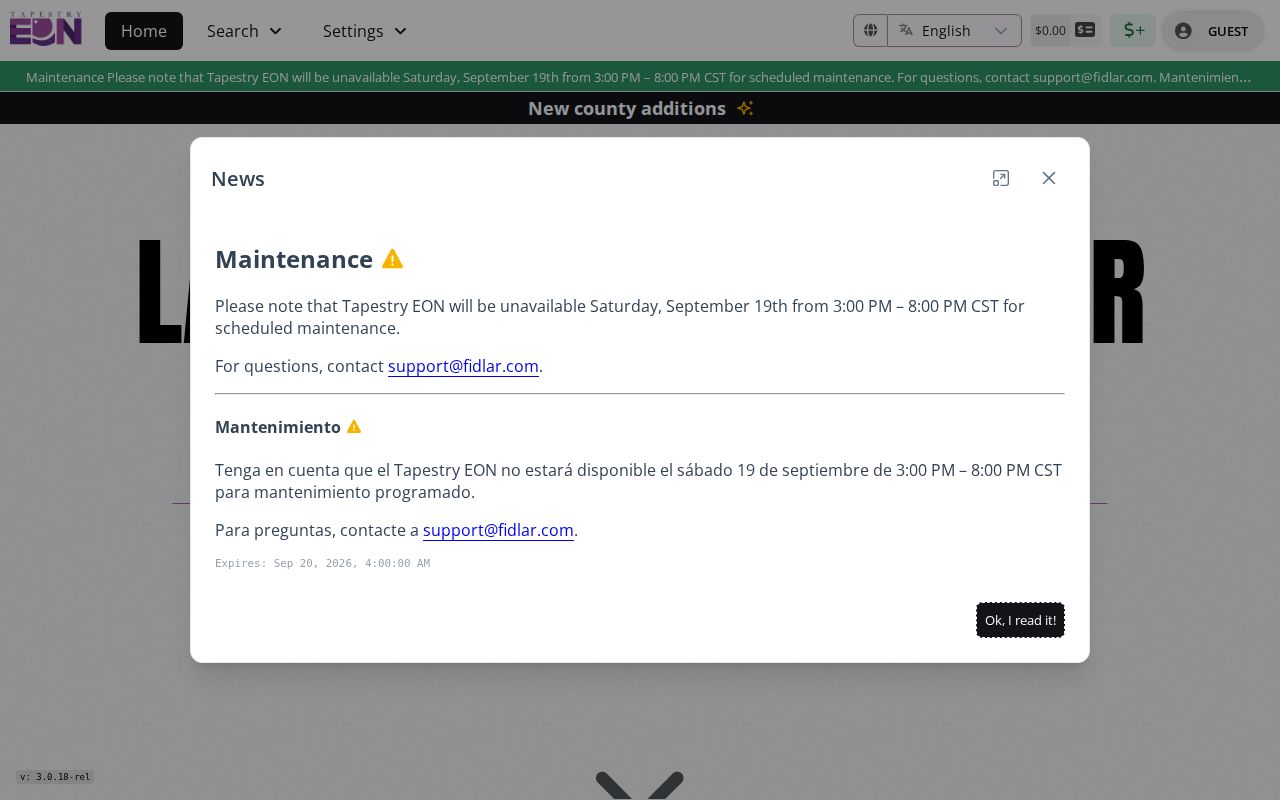
Keep the county landing page with any vendor result. It documents the official link, and the county also names Fidlar Laredo as an online route.
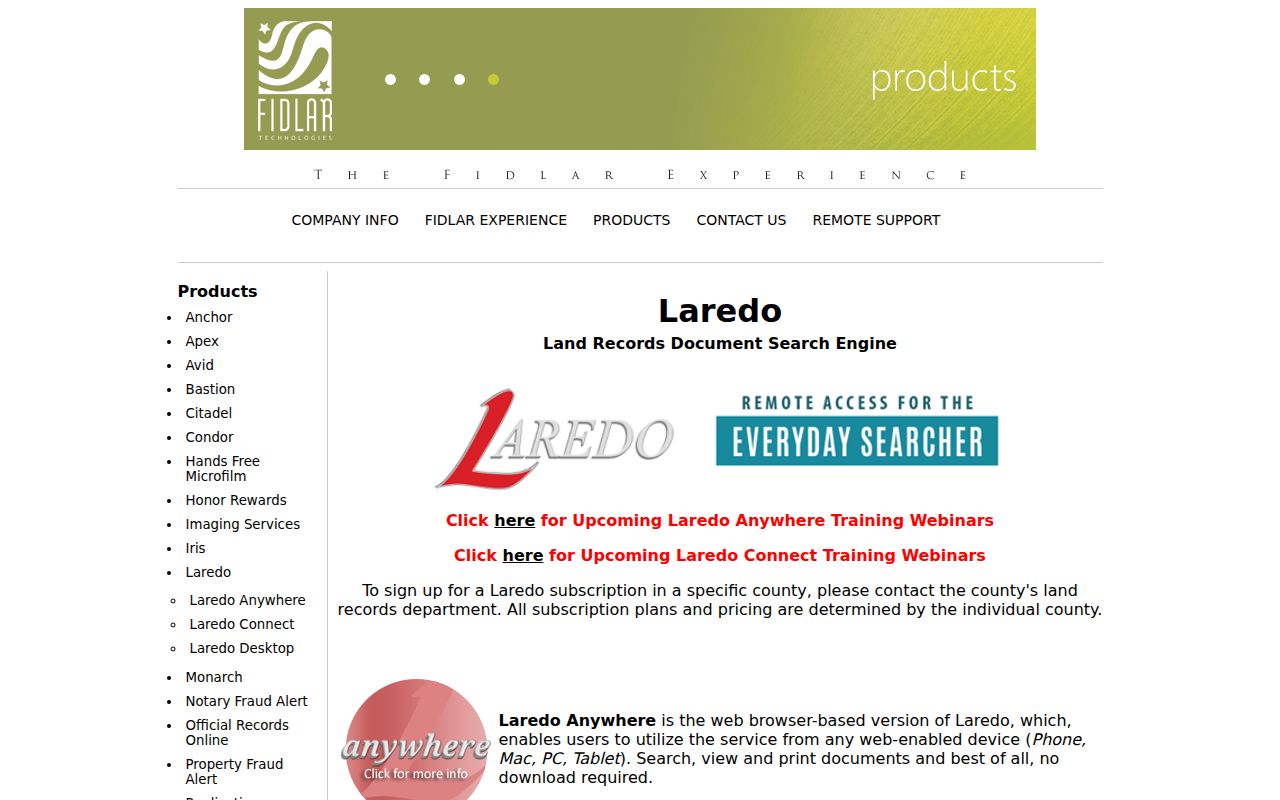
Check current login and fee terms rather than assuming both services provide identical access.
Obtain a Midland County Deed Copy
Anyone may inspect or copy recorded documents. Pull an online image when one exists, or visit the vault at 220 W Ellsworth Street. Recording runs 8:00 a.m. to 4:00 p.m. weekdays. Vault hours are 8:30 a.m. to 4:00 p.m. Call 989-832-6820 or email RegisterOfDeeds@co.midland.mi.us before traveling for an older volume.
Plain copies cost $1 per page. Certification adds $5 plus $1 per page. Standard recording runs $30 regardless of page count, while extra references, tax certificates, transfer taxes, and card processing may add charges. Cash and check are accepted, and the FAQ cites an approximately $1.50 card fee.
Recorded is not guaranteed. Acceptance into Midland County deed records does not prove the grantor owned every claimed interest or that title is clear. The office cannot prepare documents or give legal advice.
Recording Rules Shape Midland County Deeds
Recording standards are strict in Midland County. Signatures must be original and written in dark ink. Documents need printed names, acknowledgment or notarization, and the grantee's address, plus the drafter's address for anything dated after January 1, 1964. Each document states its event on the first line. One recordable event per document is the rule. Suitable paper, margins, a legal description, and transfer value or the proper affidavit round out the list, and English translations, certified death records, trust papers, and raised-seal court orders may need special handling.
The office provides no notary. The County Clerk next door may notarize for a small fee. E-recording is accepted except for raised-seal court documents and death certificates, and the requirement sheet warns against including more than four sequential Social Security digits unless law requires them.
Midland County Deed Research Before 1958
Early property history means finding aids, not portal searches. Start with the name index. Then retrieve the cited book or microfilm. Assessment rolls from 1855 through 1910, the 1936 through 1939 Rural Property Inventory, plat books, newspapers, probate files, and survey materials can bridge a name or description. None of them replaces the deed itself.
Midland County was laid out in 1831 and organized in 1850. Early descriptions rely on townships 13N through 16N and ranges 2E through 2W, so modern street search is often weak. The Archives of Michigan guide identifies holdings, while the vault remains the place to follow actual deed references.
Watch Midland County Names for New Filings
The property-fraud alert can notify a subscriber of new filings. It works when a document is recorded under a chosen name. Enrollment runs through the official Midland Property Fraud Alert portal. It cannot prevent recording. It proves no fraud and replaces no title search. If an alert arrives, retrieve the document and compare its legal description and parties. Contact the Register of Deeds. Preserve the notice date and instrument reference rather than judging validity from the alert alone.
Separate Midland County Deeds from Related Filings
A mortgage states a security interest, and it may be assigned afterward. That is not satisfaction. A discharge or release is the instrument that proves the loan was paid. Watch the timing. A release can be recorded years after payoff. It may cite nothing but a liber and page.
Liens demand their own review. Construction liens, tax liens, judgment liens, restrictions, and rights-of-way each attach through the legal description and recorded references. A shared surname proves nothing about the target parcel. Court files can clarify a quiet-title suit, partition, foreclosure, or land-contract forfeiture. The public MiCOURT result is informational only. Pair a clerk's official order with any recorded lis pendens, judgment, release, or conveyance. The recorder is the source for the land filing itself.
Search from before the apparent acquisition forward. Land contracts complicate the picture. Possession and eventual conveyance can split apart. You may need the recorded contract plus any deed, release, or District Court forfeiture file.
Easements, covenants, drainage rights, subdivision plats, and condominium declarations can burden land. They may never register as a lien. Read the grant and every referenced exhibit. A GIS map can show a corridor. It cannot fix the width, duration, beneficiaries, or release of a recorded right.
Match Every Midland County Deed to the Land
The legal description anchors any Midland County deed search. Platted parcels read differently. They rely on subdivision, lot, block, and amendments. A metes-and-bounds tract turns on courses, distances, bearings, monuments, and the names of neighboring owners. Condominiums add their own layer. You may need the master deed, plan, unit number, percentage interest, common elements, and every later amendment.
Compare acreage, section, road frontage, and instrument references. Do not force a match. Splits and combinations can leave parent and child tax accounts alive at once, while older deeds still carry predecessor descriptions. A city parcel format can even resemble a brand-new parcel when the land itself has not changed.
Ambiguity deserves a written record. Note the conflict plainly and take it to the Midland County recorder or a qualified professional. A useful note might say that BS&A lists one parcel number, the deed describes a named half-quarter, and the GIS polygon appears to swallow road right-of-way.
Estate transfers need care. Treat a death record or obituary as a lead. Probate files may hold a will, inventory, letters of authority, an order of sale, or a distribution path. The later deed records the actual land transfer. Survivorship, trust, and representative deeds can break a simple seller-to-buyer pattern, so keep the authority document and the recorded conveyance together.
A deed can also point outward through attached exhibits and prior references. Follow the plats, easements, declarations, amendments, and earlier liber and page entries it cites. Check each cross-reference against the same legal description. This record graph beats a bare list of owner names because it keeps every interest tied to its source instrument.
Save each reference in order. Note any missing exhibit, then ask the Register of Deeds for the exact instrument instead of every filing tied to a broad surname.