
Fields Inside Midland County Property Tax Records
Assessment and tax systems answer two different questions. The assessor sets values and classification for Midland County parcels. The Treasurer, by contrast, tracks tax accounts, payments, delinquency, forfeiture, and foreclosure. Whenever you copy a figure, keep the parcel number and tax year written beside it.
| Record Field | Meaning | Custodian |
|---|---|---|
| Assessed value | Generally 50 percent of true cash value under Michigan's system | Local assessor |
| SEV | State Equalized Value after equalization | Assessor and equalization records |
| Taxable value | The capped levy base, subject to transfer uncapping | Assessment roll |
| Tax bill and payment | Charges, payments, and current balance | Local treasurer, then county Treasurer after delinquency |
| Delinquency status | Interest, fees, forfeiture, or foreclosure stage | Midland County Treasurer |
A tax bill is neither a sale price nor an appraisal. Midland County builds it by applying millages and other lawful charges to taxable value, after subtracting any exemptions and adjustments that apply.
Search Midland County BS&A by Three Keys
Midland County property tax records live in the county BS&A service, which accepts three keys: an address, an owner name, or a parcel number. Pick your key and search. Categories span Tax, Delinquent Tax, Special Assessment, Building Department, utility, and receivable records. A result can carry the owner of record, reference number, address, parcel details, the legal description, tax information, and tax-history tabs.
| Search Input | Use It When | Check Before Relying |
|---|---|---|
| Address | The current street location is known | Unit, direction, postal city, and municipal account |
| Name | The account owner is known | Spelling, trust or entity form, and update lag |
| Parcel number | An exact current account is needed | City-to-county conversion, split, or merger |
The official BS&A property search capture shows these county search routes.
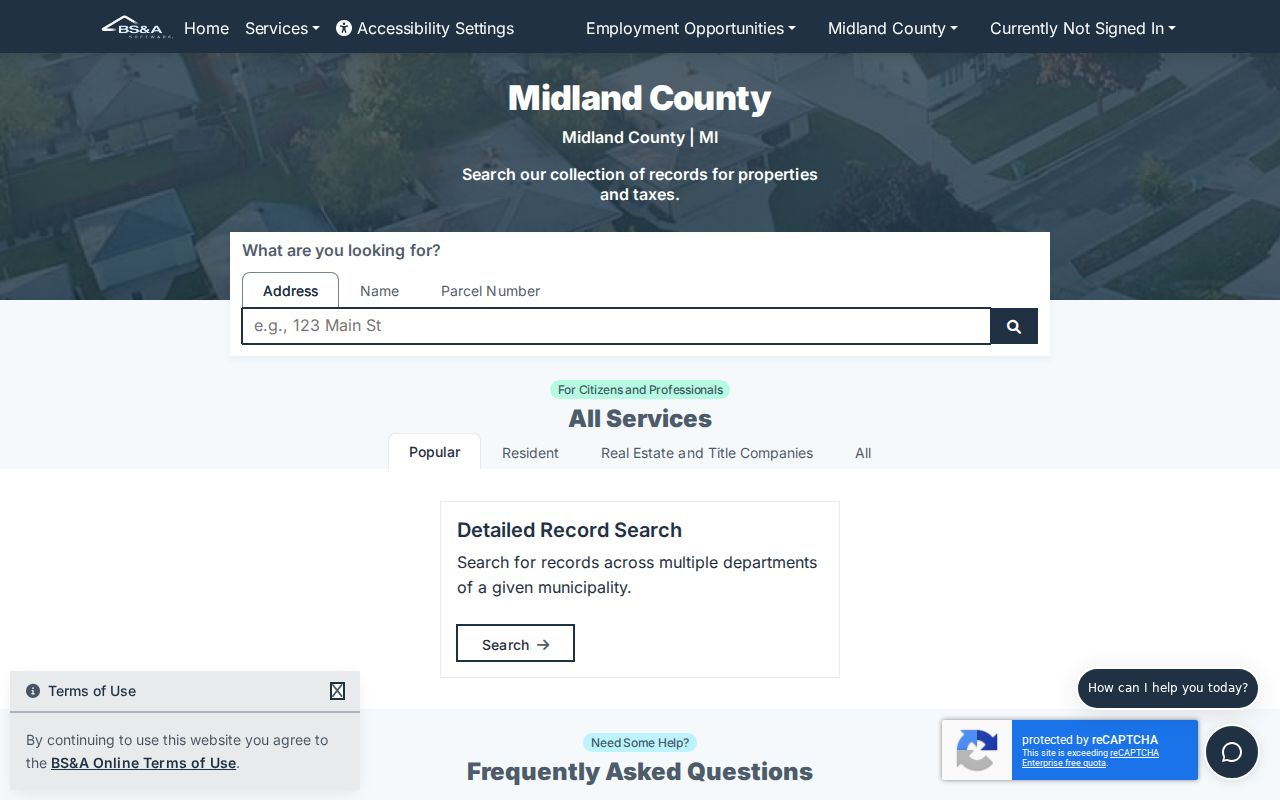
Treat the screen as a discovery point, not a final word. Values and payment states get updated, so preserve the access date and the disclaimer along with anything you save.
Look Up a Midland County Tax Bill
Start by confirming the parcel identity. Then pull the assessment record, the tax bill, and any delinquent balance as separate items. A City of Midland parcel number may need conversion before the county system will accept it. The Treasurer's own example shows city 14-12-50-011 becoming county 180-141-250-011-00. Split or merged parcels deserve a direct check, though. Never rely on a blind conversion.
- Find the parcel by address or owner in BS&A or FetchGIS.
- Copy the current parcel number, tax year, class, assessed value, SEV, and taxable value.
- Open the tax and delinquent-tax categories for charges and payment status.
- Check whether a Principal Residence Exemption appears and which year it affects.
- Ask the Treasurer to confirm an unclear balance, forfeiture, or foreclosure stage.
- Assessed value
- The assessor's value, generally one-half of true cash value.
- Mill
- One dollar of tax for each $1,000 of taxable value.
- Principal Residence Exemption
- The Michigan exemption from up to 18 mills of school operating tax for a qualifying principal residence.
- Tax lien
- A legal claim arising from unpaid property tax, not the same as a completed title transfer.
Proposal A Changes Midland County Taxable Value
Proposal A splits value into three figures. Assessed value and State Equalized Value generally sit at 50 percent of true cash value. Taxable value is the capped base the levy uses. An ownership transfer uncaps it the next year. Buyers file Property Transfer Affidavit Form L-4260 with the assessor within 45 days.
The affidavit is not the deed. The deed or land contract records the conveyance. The affidavit supplies transfer information, and the assessor decides the tax result. A late filing can delay uncapping. The assessor still learns of transfers through deeds, name changes, PRE papers, or other reliable sources.
Note: Compare figures from the same tax year, since mixing a prior assessment with a current taxable value creates a false discrepancy.
Midland County Delinquency Has a Set Sequence
Unpaid Midland County taxes turn delinquent on March 1. The account then takes a 4 percent administration fee plus 1 percent interest. Interest adds another 1 percent monthly beginning in April. A $15 certified-mail charge arrives in October. Forfeiture follows on the next March 1, bringing a $175 fee, recording and posting costs, and 0.5 percent interest for the prior twelve months.
A foreclosure judgment has its own deadline. If the balance stays unpaid by March 31 after that judgment, the parcel can be foreclosed and offered at public auction. Track the account by tax year. A payment or hardship plan can change things. Missing a bill in the mail excuses no taxpayer. The Treasurer FAQ shows the official delinquency, forfeiture, and foreclosure rules.
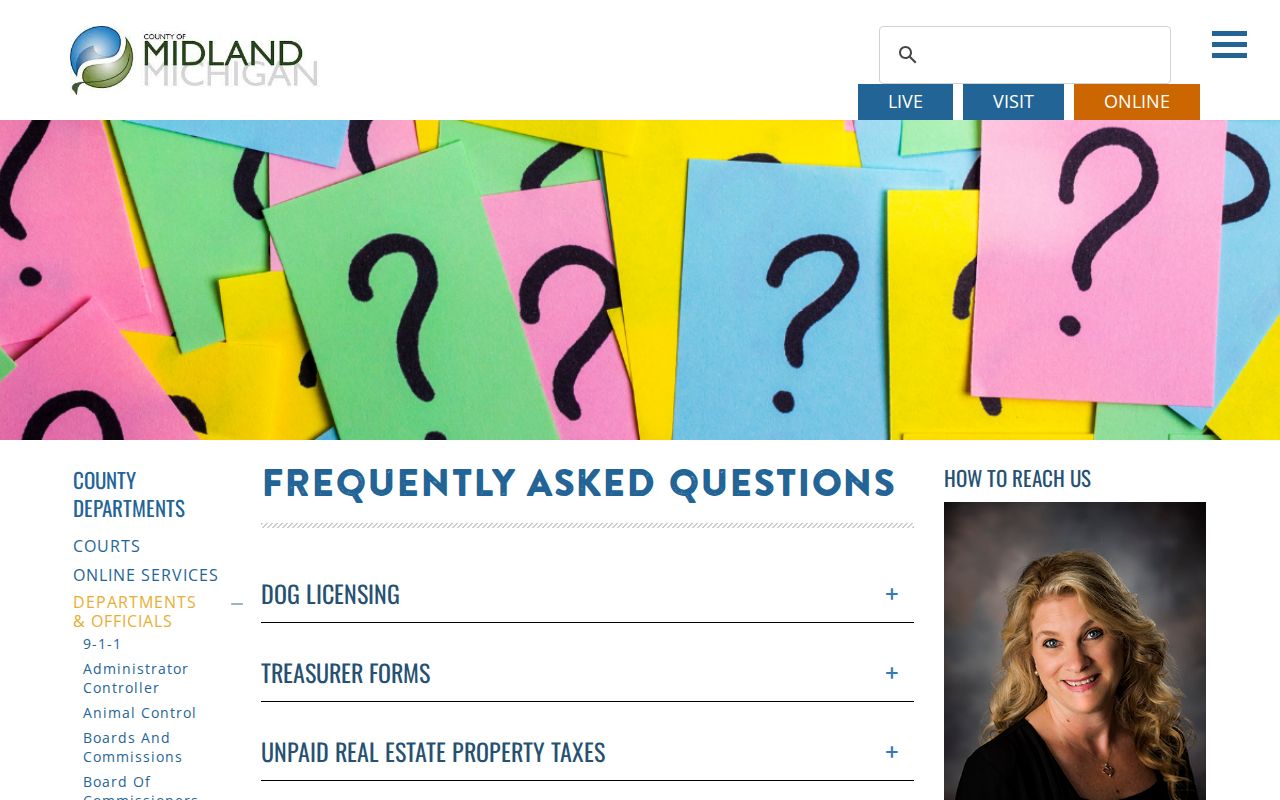
The county treats each delinquency stage separately. A delinquent flag, forfeiture, a foreclosure judgment, auction, and a recorded conveyance all stand apart as distinct events in the sequence.
Payments and Help at the Midland County Treasurer
Treasurer Catherine L. Lunsford runs the office at 220 W Ellsworth Street in Midland. Doors open weekdays from 8:00 a.m. to 5:00 p.m. Call 989-832-6850 or email clunsford@co.midland.mi.us. This is the practical stop for confirming a delinquent balance or asking how a county tax record ties to a parcel.
Partial payments of at least $10 are accepted. Card payments carry a fee. A returned check costs at least $25 and starts a five-day response period. The FAQ directs taxpayers to the local treasurer and hardship assistance, so keep a dated receipt and name the parcel and tax year on any payment question.
PRE and Midland County Property Tax
Michigan's Principal Residence Exemption, or PRE, can strip up to 18 mills of school operating tax from a qualifying principal residence. The City of Midland sets June 1 and November 1 filing deadlines in its tax calendar. An exemption changes the levy only. It does not alter title, prove occupancy for every legal purpose, or make taxable value equal market value.
Check the tax roll for Midland County to confirm the PRE is recorded for the right year, and ask the local assessor about the current form or correction procedure. Transfers, late filings, denials, and audits can each shift the outcome from one year to the next. Keep the exemption paperwork beside the tax bill and assessment notice. A single portal label is not enough on its own.
Contest a Midland County Assessment on Time
A Midland County assessment dispute begins locally. Talk to the assessor first, then take unresolved residential claims to the March Board of Review before any Michigan Tax Tribunal filing. The City of Midland's 2026 Board schedule runs March 9 through 11 and asks for comparable sales, appraisal evidence, and the owner's opinion of value. Residential and agricultural appeals are due July 31. Commercial, industrial, and utility cases must be filed by May 31 after local-board review.
Assemble the packet carefully. Include the parcel, tax year, property class, and inspection facts, plus comparable transactions and the specific issue at stake, whether that is valuation, classification, exemption, or uncapping. A sale filter or ECF study helps with research. Neither one is a parcel appraisal.
Appeal windows are year-specific. Confirm the current local Board dates and Michigan Tax Tribunal deadline before filing; an old calendar is not safe to reuse.
Request Missing Midland County Tax Records Precisely
Start with BS&A, the assessor, or the Treasurer. These offices hold routine tax and assessment records, but when an existing administrative record is not offered through normal access, Midland County accepts Michigan FOIA requests through NextRequest. Be precise. Name the parcel, address, tax year, department, record type, date range, and format you want. Five business days is the standard response window. A ten-business-day extension is possible. Fees for search, review, redaction, copying, and mailing can apply. The law opens sufficiently described existing records, not new calculations or legal opinions, so request the document showing a decision, payment, notice, or adjustment.
A Midland County Tax Sale Is Not Clear Title
Winning a bid settles nothing. A successful Midland County tax auction bid does not establish the final grantee. The paper trail does. Collect the tax bill, delinquent statement, notices, forfeiture record, foreclosure judgment, redemption record, auction result, and the later deed from the foreclosing governmental unit or land bank. The recorded conveyance completes the legal record.
Occupancy and title are separate questions. Map labels prove nothing. Neither does tax status; when ownership is the question, compare the final deed through the Midland County deed records route, and use the value guide when the value fields confuse you.
Timing changes everything. Partial payment, hardship assistance, redemption, or a later county disposition can shift the picture between two searches, so record the access date, the tax year, and the exact status words shown. Watch for disappearing parcels too. If a parcel drops off an auction list, ask for the existing record explaining its removal rather than assuming payment, cancellation, or transfer.
An older delinquency does not mean foreclosure. Check the balance and legal stage with the Treasurer. A foreclosure judgment and an auction notice are not interchangeable with the recorded deed naming the new grantee. Exact dates and status terms keep those events in order.
Some tax bills hide more than property tax. A special assessment or taxing-district charge will not appear in the base calculation. Check the BS&A category. Then request the resolution, roll, or billing record from the responsible public body. FOIA does not force a new explanation, but the county can release a sufficiently described existing record unless an exemption applies.